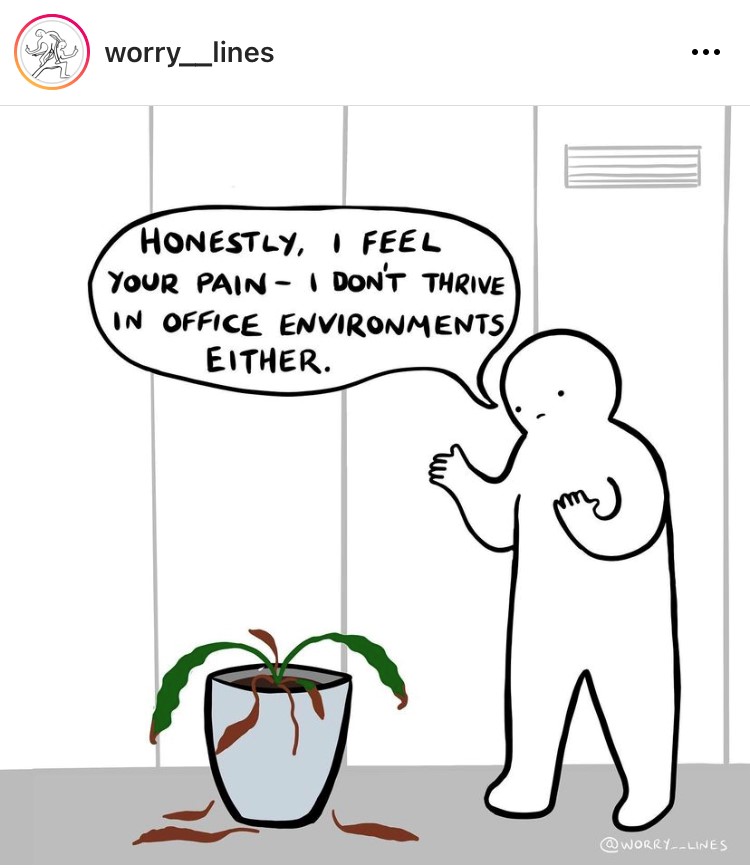
I follow @worry__lines on Instagram and thought this cartoon, from 31 March, was amusing. For me, it caught the zeitgeist as we all adjust to hybrid working – that is, a combination of working from home and working from an office.
I’m noticing an almost permanent change to ‘work’, as the hybrid model of working from home and some time spent in an office becomes more normal. I speak for those of us who have been working for a number of years. When I think of all the friendships and relationships I have had over the years from people I met through ‘work’, I hope that regular office time will still be a thing for young people just entering the world of work, even if only a few days a week.
I was interested by an event with Julia Hobsbawm via the Trouble Club last month, about her book The Nowhere Office. Even better, I watched online so I didn’t have to schlepp up to London for an hour’s event.
Julia believes that we, in the knowledge economy, are extremely unlikely to go back to working full-time in offices for three reasons. Firstly, as she says, work wasn’t working for many people. There was an epidemic of stress and overwork.
Secondly, we didn’t notice while we were performatively following norms and turning up at offices for meetings and ‘to work’, that the technology allowing us to do all of this from home already existed.
Thirdly, movements such as Me Too (Feminism), Black Lives Matter and – even more pronounced in the four weeks since that event – uprising around economic uncertainty are happening and they’re changing our notions of work.
It was a really interesting discussion that covered lots of detail – including asymmetry, or the unwillingness of some to coincide with others and all go into an office at the same time. Also, our relationships with screens and how, just like alcohol, food and sleep, we each individually have to manage and monitor how much screen time we have.
Lots of people are writing about work, including this piece from The Guardian called Work Isn’t Working.
It got me wondering how many of us are now TWATs? An acronym for people working Tuesdays, Wednesdays and Thursdays in an office? Fortunately I am simply a Thursday’s child, one who has far to go (as in this nursery rhyme that my grandma used to tell me).
An ITN colleague reports that on Monday 14 March London tubes were quiet; on Thursday 17 March they were heaving (as I can also attest). They were also pretty busy on Thursday 24 March and again on Thursdays 31 March and Thursday 7 April.
Then on my way home from a busy London on Thursday 17 March, I read this piece in the Standard, saying London offices are fuller than at any time since the start of the pandemic. Though what struck me was that average occupancy of London office space was only about 63 per cent before the first lockdown – which suggests there were already quite a lot of empty offices in the capital pre-Covid. Again, we must conclude that work, for some, wasn’t working.
Compare this piece in The Guardian about the Great Regret and a need for a reality check after the Great Resignation / job shuffle.
This is funny from The Guardian citing Sky research into people napping, watching TV, sharing memes and all the other things we do while working from home
This is also funny and true, about the pointlessness of almost all meetings.
In other news
This article from The Spectator is worth reading on the soft censorship that the online harms bill could usher in – with tech giants able to censor anything they deem too risky to share. It’s already happening, according to The Spectator. Though Press Gazette quotes Julian Knight MP and chair of the culture select committee as saying it’s only a bill and will be amended many times before it becomes law.
This list was interesting from Press Gazette about the best paid news executives in the UK industry. Just 36% of the top 50 are women.
On 30 March it was 25 years since the launch of Channel 5. I remember it well although I was working on a European media magazine at the time, Media & Marketing Europe – for Emap Media. Once I’d moved to Media Week a year or so later and then on to Broadcast magazine, Five became a regular fixture of my working life and I made friends with several people working there which continue to this day. So Happy 25th Birthday, Five/C5. Long may you prosper.
I could write acres about this government’s moves to privatise Channel 4 and acres have already been written…
First there was this announcement; then, while C4 News was on air on Monday 4 April, the privatisation of C4 was confirmed. Or rather, the government confirmed its intention to privatise C4 before the next election. The current leadership of C4 will not go down without a fight and there is speculation that the necessary legislation won’t get through the House of Lords. But, as MP Lucy Powell said, a hell of a lot of parliamentary time is going to be taken up with this while most of the country doesn’t care whether C4 is privately or publicly owned and, more importantly, the cost of living is going through the roof.
This is interesting from Paul Mason in the New Statesman about how privatisation could be stopped and, more importantly, how to ensure a robust C4 into the future.
Privatising C4 is a bad idea for lots of reasons – it ain’t broke and doesn’t need fixing; the livelihoods of many, many independent producers rely on it; and a public service C4 sits at the heart of a thriving creative economy in this country.
I won’t go on. But there is a petition you could sign here.
That’s quite enough for one month. Happy Easter! See you in May when we will be almost halfway through the year. Where IS the time going?
 Lucy Rouse PR Blog