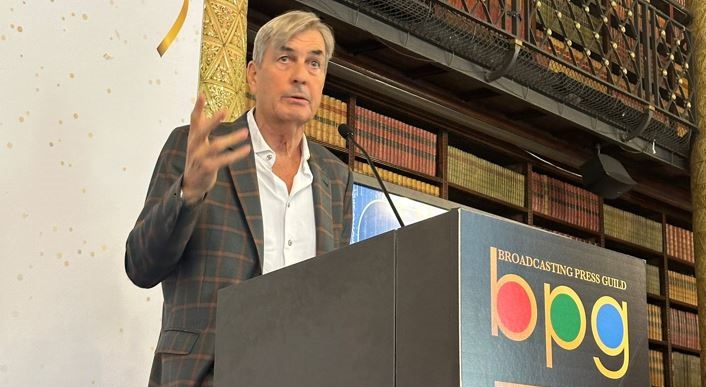
Last month I was at the 50th Broadcasting Press Guild Awards lunch, where journalists who write about television and radio vote for their award-winning shows and presenters of the year. Mr Bates vs The Post Office and Happy Valley were among the big winners.
I was on a table with DJ Ken Bruce who won the best audio presenter award, and I enjoyed chatting to his daughter who accompanied Ken to the event.
Because it was the 50th Awards, we also voted on the top 50 shows of the past 50 years, with ITV’s iconic documentary series 7 Up taking first place, followed by the BBC’s Life on Earth and ITV’s The World At War in second and third place. You can read the full release here.
The BPG Awards made the news, not just for our top 50 programmes, but also because Left Bank Pictures ceo Andy Harries – executive producer of The Crown and so much else – used an acceptance speech for his outstanding contribution to broadcasting award to warn us to nurture public service broadcasters.
Harries said: “TV is a big business and we are very good at it – much of our top UK talent play a key part in US funded TV shows, and mega Hollywood movies are being shot here in the UK. But despite all our success, I am worried that the very heart of our UK business – our public broadcasters – are increasingly looking vulnerable with ad money now draining from ITV and C4 to Amazon and Netflix, and the BBC’s licence fee falling far short of the rate of inflation.”
No sooner had his remarks been shared, than BBC director general Tim Davie kicked off another review of its licence-fee funding model, acknowledging that it may need to be more commercial in future. This wasn’t helped by Dr Who writer Russell T Davies saying the end of the BBC is inevitable. I certainly hope not.
The value we get from the BBC licence fee, in terms of linear channels, iPlayer, BBC Sounds, radio stations, websites, apps, education, information and entertainment is incredible. Yes, the licence fee needs reform but secure funding for the BBC, and the safeguarding of all the public service broadcasters including ITV and Channel 4, must be on a new government’s agenda.
I’ve been working with Good Faith Partnership, a social justice consultancy, for about six weeks now and am still loving it. Their biggest project, in some ways, is the Warm Welcome Campaign which encourages community spaces to open and offer a free, warm and welcoming space for people who are lonely or suffering with the cost of living and fuel.
This month I take over their social media profiles across X, Facebook, Instagram and LinkedIn so do keep an eye out for posts and please like and share.
Last month I attended an online media training webinar with the CIPR Wessex group I’m a member of, with Adam Kirtley, a journalist based in Winchester. Adam shared some very useful and sometimes funny clips about media interviews, where they’ve gone right and where they’ve gone wrong (Merlin Entertainments got a positive mention).
I did take time out for a weekend break in Gdansk, Poland, which wasn’t at the top of my must-see list, I must say, but which is very cheap to fly to and where the Air BnB accommodation was also very affordable and lovely. I’d highly recommend the city for a short break: loads of history, Dutch architecture and museums including the World War II Museum which is sobering but necessary.
In other news
There was an almighty row about image editing, following the recall by press agencies of an image of the Princess of Wales with her three children which was released on Mother’s Day in the UK and meant to allay concerns about the Princess’s health following abdominal surgery earlier this year. The Guardian helpfully published an analysis of anomalies in the photo.
Then the Princess of Wales went public with a diagnosis of cancer, and appears to be being left in peace to complete her treatment.
This was an interesting story about AI and quality of life from The Guardian last month. The paper is right about the need for checks and balances as AI develops. But a former colleague @Andy Fry highlighted how The Guardian scaremongers about AI taking jobs in this story, pointing out that this is a worst case scenario and a best case scenario involves growth and no job losses.
Finally, Press Gazette continues to report on the flow of eyeballs and ad revenue to major tech giants, rather than newspaper publishers online. This story documents how all-important ad revenue is now flowing to a third wave of online retail giants, following the second wave which went to Google and Meta (Facebook and Instagram).
That’s all for this month. See you in May. Can it really be April so soon after only just saying goodbye to January?
 Lucy Rouse PR Blog